Jacob Acevedo
Game & Level Designer
VERGE
OVERVIEW
VERGE is a 1st person hack-n-slash developed by a team of five.
My work included:
-
Authoring design documents to guide development.
-
Designing and building out the arena's layout and architecture.
-
Lighting and populating the level.
-
Communicating with artists to ensure a cohesive aesthetic.
-
Working collaboratively cross-discipline, particularly VFX, UI, and Scripting, to maximize efficiency and meet benchmarks.
CONTRIBUTIONS
Planning and Documentation
During production I assisted in the composition of a 'game pitch' document.
The Pitch document lays out a hierarchical framework, both mechanically and visually of the title's core elements.
Defining the foundations first provided team members with a strong reference point to evaluate their own ideas.

Page 1 of the pitch, highlighting the intended tone and overall vision.

The final page highlighting VERGE's target demographic.
Like other projects, I started my level design process by iterating within a single text document.

A snippet of the first planning document, which set the groundwork for future design.
The sections I fill out first are Goals and Constraints.
GOALS:
What I am trying to achieve and why?
-
Emphasize the narrative context of dystopian gladiatorial combat.
-
Make an area which highlights VERGE’s combat and movement mechanics.
-
Allow for flexible future implementation of different layouts.
CONSTRAINTS:
What are the non-negotiables for this level?
-
Player cannot leave area without combating enemies.
-
Level must be contained within a hexagonal or similar space mimicking an arena.
-
Area must take no more than a few seconds to cross.
Next I add to the following sections, flowing between them and iterating until I have a solid vision for the level.
ELEMENTS:
What do I have at my disposal to make the level with?
SEQUENCE:
What goes through the player's head moment to moment as they play?
QUESTIONS:
Which parts of this design need more clarity or detail?
GAMEPLAY BEATS:
What are the types of gameplay, phases or key moments in the level?
Layout Design
Using the brainstorming document as reference I sketch out a few layouts. These start with geometric shapes and general lanes. Once the overall shape is defined I add more detail in map form.

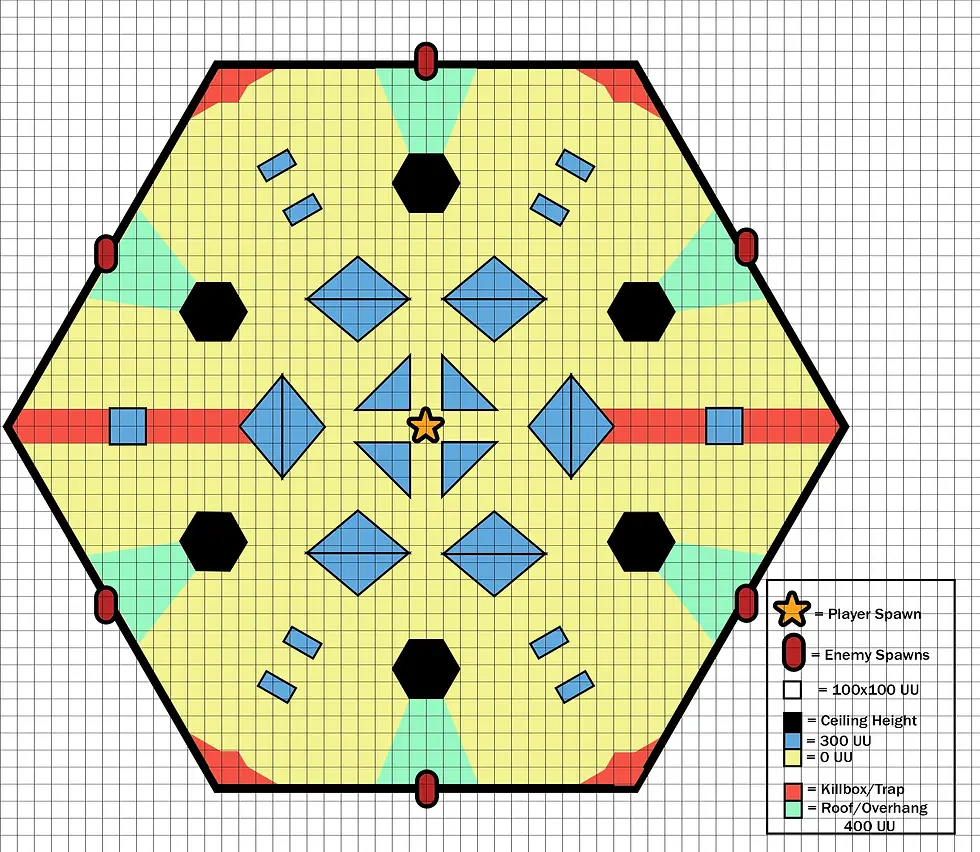
Playtesting revealed that while the layout encouraged movement, it also obscured player vision more than anticipated.
In addition, with our artists busy working on modeling and texturing enemies, we had to account for project deadlines. A simpler map would reduce future workload.

An early altered version of the original design.
Players responded positively to the changes, finding navigation easier.
Given the target audience of our title, we figured the loss in variety was worth the increase in overall flow.
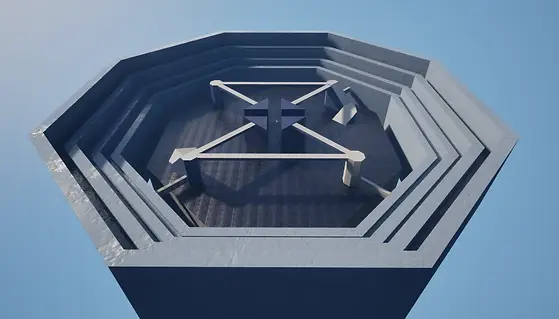
The revised layout.
Lighting and Population
With the block out complete, I filled the role as primary environment artist, populating, detailing, and lighting the scene.
This involved pulling from publicly available assets and adjusting them to fit the intended art style.


